- 您現在的位置:買賣IC網 > PDF目錄369995 > PF48F3P0ZB00 (Intel Corp.) Coaxial Cable; Coaxial RG/U Type:6; Impedance:75ohm; Conductor Size AWG:18; No. Strands x Strand Size:Solid; Jacket Material:Polyvinylchloride (PVC); Capacitance:16.2pF/ft; Conductor Material:Steel; Conductor Plating:Copper RoHS Compliant: Yes PDF資料下載
參數資料
| 型號: | PF48F3P0ZB00 |
| 廠商: | Intel Corp. |
| 英文描述: | Coaxial Cable; Coaxial RG/U Type:6; Impedance:75ohm; Conductor Size AWG:18; No. Strands x Strand Size:Solid; Jacket Material:Polyvinylchloride (PVC); Capacitance:16.2pF/ft; Conductor Material:Steel; Conductor Plating:Copper RoHS Compliant: Yes |
| 中文描述: | 英特爾StrataFlash嵌入式存儲器 |
| 文件頁數: | 21/102頁 |
| 文件大小: | 1609K |
| 代理商: | PF48F3P0ZB00 |
第1頁第2頁第3頁第4頁第5頁第6頁第7頁第8頁第9頁第10頁第11頁第12頁第13頁第14頁第15頁第16頁第17頁第18頁第19頁第20頁當前第21頁第22頁第23頁第24頁第25頁第26頁第27頁第28頁第29頁第30頁第31頁第32頁第33頁第34頁第35頁第36頁第37頁第38頁第39頁第40頁第41頁第42頁第43頁第44頁第45頁第46頁第47頁第48頁第49頁第50頁第51頁第52頁第53頁第54頁第55頁第56頁第57頁第58頁第59頁第60頁第61頁第62頁第63頁第64頁第65頁第66頁第67頁第68頁第69頁第70頁第71頁第72頁第73頁第74頁第75頁第76頁第77頁第78頁第79頁第80頁第81頁第82頁第83頁第84頁第85頁第86頁第87頁第88頁第89頁第90頁第91頁第92頁第93頁第94頁第95頁第96頁第97頁第98頁第99頁第100頁第101頁第102頁
1-Gbit P30 Family
Datasheet
Intel StrataFlash
Embedded Memory (P30)
Order Number: 306666, Revision: 001
April 2005
21
VCCQ
Power
Output Power Supply:
Output-driver source voltage.
VSS
Power
Ground:
Connect to system ground. Do not float any VSS connection.
RFU
—
Reserved for Future Use:
Reserved by Intel for future device functionality and enhancement. These
should be treated in the same way as a Do Not Use (DU) signal.
DU
—
Do Not Use:
Do not connect to any other signal, or power supply; must be left floating.
NC
—
No Connect:
No internal connection; can be driven or floated.
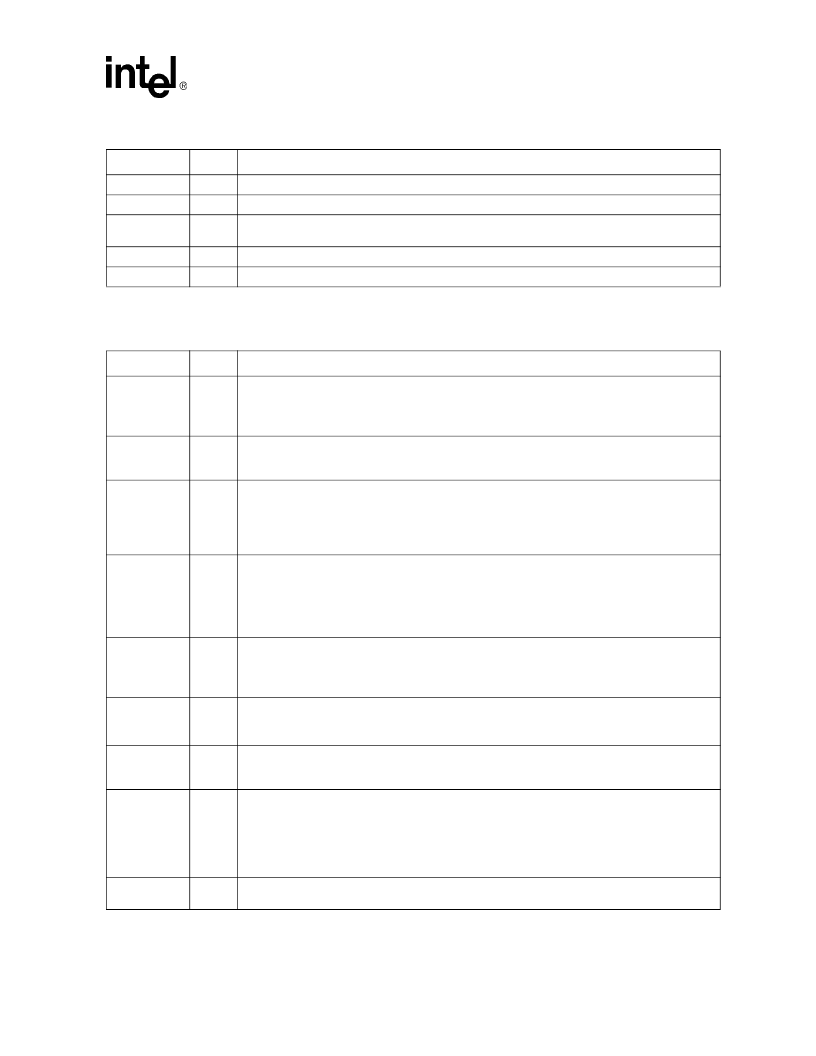
Table 3.
TSOP and Easy BGA Signal Descriptions (Sheet 2 of 2)
Symbol
Type
Name and Function
Table 4.
QUAD+ SCSP Signal Descriptions (Sheet 1 of 2)
Symbol
Type
Name and Function
A[MAX:0]
Input
ADDRESS INPUTS:
Device address inputs. 64-Mbit: A[21:0]; 128-Mbit: A[22:0]; 256-Mbit: A[23:0];
512-Mbit: A[24:0].
See
Table 6 on page 22
,
Figure 11 on page 23
, and
Figure 12 on page 23
for 512-Mbit and 1-Gbit
addressing.
DQ[15:0]
Input/
Output
DATA INPUT/OUTPUTS:
Inputs data and commands during write cycles; outputs data during
memory, Status Register, Protection Register, and Read Configuration Register reads. Data balls
float when the CE# or OE# are deasserted. Data is internally latched during writes.
ADV#
Input
ADDRESS VALID:
Active low input. During synchronous read operations, addresses are latched on
the rising edge of ADV#, or on the next valid CLK edge with ADV# low, whichever occurs first.
In asynchronous mode, the address is latched when ADV# going high or continuously flows through
if ADV# is held low.
WARNING: Designs not using ADV# must tie it to VSS to allow addresses to flow through.
F1-CE#
F2-CE#
Input
FLASH CHIP ENABLE:
Active low input. CE# low selects the associated flash memory die. When
asserted, flash internal control logic, input buffers, decoders, and sense amplifiers are active. When
deasserted, the associated flash die is deselected, power is reduced to standby levels, data and
WAIT outputs are placed in high-Z state.
See
Table 6 on page 22
for CE# assignment definitions.
WARNING: All chip enables must be high when device is not in use.
CLK
Input
CLOCK:
Synchronizes the device with the system’s bus frequency in synchronous-read mode.
During synchronous read operations, addresses are latched on the rising edge of ADV#, or on the
next valid CLK edge with ADV# low, whichever occurs first.
WARNING: Designs not using CLK for synchronous read mode must tie it to VCCQ or VSS.
F1-OE#
F2-OE#
Input
OUTPUT ENABLE:
Active low input. OE# low enables the device’s output data buffers during read
cycles. OE# high places the data outputs and WAIT in High-Z.
F1-OE# and F2-OE# should be tied together for all densities.
RST#
Input
RESET:
Active low input. RST# resets internal automation and inhibits write operations. This
provides data protection during power transitions. RST# high enables normal operation. Exit from
reset places the device in asynchronous read array mode.
WAIT
Output
WAIT:
Indicates data valid in synchronous array or non-array burst reads. Read Configuration
Register bit 10 (RCR[10], WT) determines its polarity when asserted. WAIT’s active output is V
OL
or
V
OH
when CE# and OE# are V
IL
. WAIT is high-Z if CE# or OE# is V
IH
.
In synchronous array or non-array read modes, WAIT indicates invalid data when asserted and
valid data when deasserted.
In asynchronous page mode, and all write modes, WAIT is deasserted.
WE#
Input
WRITE ENABLE:
Active low input. WE# controls writes to the device. Address and data are latched
on the rising edge of WE#.
相關PDF資料 |
PDF描述 |
|---|---|
| PF48F4P0ZB00 | Coaxial Cable; Coaxial RG/U Type:6; Impedance:75ohm; Conductor Size AWG:18; No. Strands x Strand Size:Solid; Jacket Material:Polyvinylchloride (PVC); Capacitance:16.2pF/ft; Conductor Material:Steel; Conductor Plating:Copper RoHS Compliant: Yes |
| PF48F0P0VBQ0 | Intel StrataFlash Embedded Memory |
| PF48F4444PPVBQ0 | Intel StrataFlash Embedded Memory |
| PF48F2P0VBQ0 | Intel StrataFlash Embedded Memory |
| PF48F3P0VBQ0 | Intel StrataFlash Embedded Memory |
相關代理商/技術參數 |
參數描述 |
|---|---|
| PF48F3P0ZBQ0 | 制造商:INTEL 制造商全稱:Intel Corporation 功能描述:Intel StrataFlash Embedded Memory |
| PF48F3P0ZT00 | 制造商:INTEL 制造商全稱:Intel Corporation 功能描述:Intel StrataFlash Embedded Memory |
| PF48F3P0ZTQ0 | 制造商:INTEL 制造商全稱:Intel Corporation 功能描述:Intel StrataFlash Embedded Memory |
| PF48F4000M0Y0CEA | 制造商:Micron Technology Inc 功能描述:256BA/0BA SCSP 1.8 X16C HF - Trays |
| PF48F4000P0ZB | 制造商:MICRON 制造商全稱:Micron Technology 功能描述:Micron Parallel NOR Flash Embedded Memory (P30-65nm) |
發(fā)布緊急采購,3分鐘左右您將得到回復。